
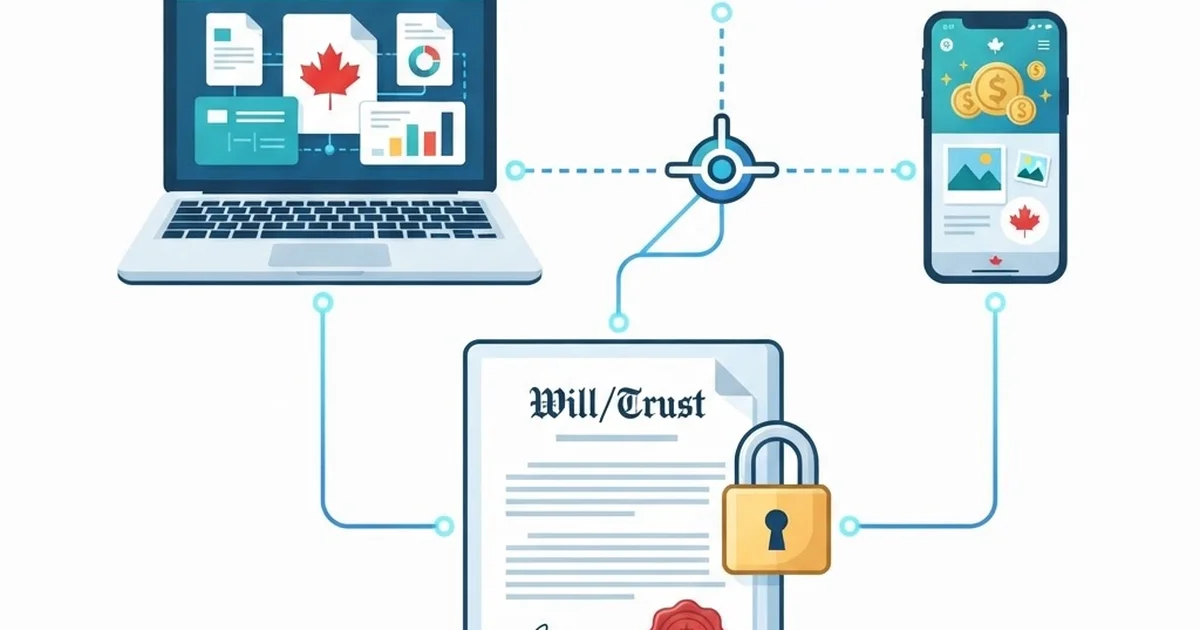
When most Canadians think about estate planning, they think about the house, the bank accounts, the RRSPs, and the family heirlooms. But for an increasing number of Canadians, a significant portion of their wealth and identity exists entirely online — cryptocurrency, investment platforms, digital business assets, social media accounts, cloud storage, and more.
These digital assets are real. They have value. And without specific planning, they can be lost forever when you die. In some cases, the value is obvious — a Bitcoin wallet with $50,000. In others, it is less visible but equally important — a Facebook business page with 10,000 followers, a domain name that generates revenue, or a Google Drive full of family photos that no one else can access.
What Counts as a Digital Asset?
Digital assets fall into three broad categories:
- Financial digital assets: Cryptocurrency wallets (Bitcoin, Ethereum, etc.), online investment accounts (Wealthsimple, Questrade), peer-to-peer lending accounts, PayPal balances, and digital payment platforms.
- Business and intellectual property: Domain names, websites, blogs that generate ad revenue, digital storefronts (Shopify, Etsy), software licenses, and digital content (e-books, courses, stock photography portfolios).
- Personal and social: Email accounts, social media profiles (Facebook, Instagram, LinkedIn, Twitter/X), cloud storage (Google Drive, iCloud, Dropbox), streaming subscriptions, online photo libraries, and digital memberships.
Why Digital Assets Are Different
Physical assets are accessible. If you leave a house, a bank account, or a safe deposit box, your executor can find it, value it, and distribute it. Digital assets are different in three critical ways:
They are invisible. If no one knows they exist, no one will look for them. A cryptocurrency wallet with no record of its existence or access credentials is permanently lost. An estimated $140 billion in Bitcoin is already permanently inaccessible due to lost keys and deceased owners who left no instructions.
They require access credentials. Unlike a bank account, where the executor can present a death certificate and probate to gain access, many digital platforms have no process for transferring account access after death. If your executor does not have the password, the recovery email, or the two-factor authentication method, the account may be permanently inaccessible — regardless of legal authority.
They are governed by terms of service, not just estate law. When you create an account on a platform, you agree to that platform's terms of service. Many platforms state that accounts are non-transferable, that access terminates on death, or that the platform has the right to delete accounts after a period of inactivity. These terms can override your will.
The Legal Framework in Canada
Canadian estate law has not fully caught up with digital assets. Unlike some U.S. states that have adopted the Revised Fiduciary Access to Digital Assets Act (RUFADAA), Canada does not have comprehensive federal legislation governing access to digital assets after death.
Your will can grant your executor authority over digital assets, but the practical ability to access them still depends on having the right information. This makes the non-legal planning — documenting what you have and how to access it — as important as the legal planning.
What to Document
Create a digital asset inventory that includes:
- Every financial account: Platform name, account type, approximate value, and how to access it
- Cryptocurrency: Wallet type, wallet address, and where the private keys or seed phrase are stored. Without the seed phrase, the wallet is permanently inaccessible.
- Business assets: Domain registrar accounts, hosting accounts, social media business pages
- Cloud storage: What is stored and where
- Subscriptions and recurring payments: Anything that will continue to charge a card after death
Do not put passwords, private keys, or seed phrases in your will. A will becomes a public document after probate. Instead, store credentials in a secure password manager or sealed envelope with your lawyer, and reference the location in your will.
How to Include Digital Assets in Your Will
Your will should include a general grant of authority over digital assets to your executor, referencing a separate digital asset inventory maintained outside the will. Key clauses:
- A broad definition of digital assets covering current and future types
- Authority for the executor to access, manage, transfer, or close digital accounts
- Instructions for specific high-value assets
- A reference to the external digital asset inventory
- Instructions for social media accounts (memorialize, delete, or grant access)
Cryptocurrency: Special Considerations
Cryptocurrency is the most at-risk digital asset. If private keys or seed phrases are lost, the assets are gone permanently. If you hold cryptocurrency, document the type and quantity, specify hot vs cold wallet, store seed phrases separately from the will, and consider a multi-signature wallet for large holdings. Cryptocurrency is treated as a commodity by the CRA — disposing of it may trigger capital gains.
Review Your Digital Estate Annually
Digital assets change faster than any other category of estate planning. Review your inventory at least once a year to ensure it is current.
Getting It Done
At Wills Made Easy, a licensed legal professional can help you structure your estate plan to include digital asset provisions. A single one-hour appointment covers your will, power of attorney, and personal directive. Find your city to get started, or check our flat-rate pricing — $395 for individuals, $495 for couples.